Top Portable Energy Monitor for Global Buyers?
Choosing the Top Portable Energy Monitor for Global Buyers requires more than comparing screen size and battery life. A useful device should reveal where electricity disappears, from a warm laptop charger to an overnight appliance. The International Energy Agency’s Energy Efficiency 2023 report found that global energy intensity improved by about 2.2% in 2022. That progress remains insufficient for long-term climate targets. Small measurements can still support better daily decisions.
Energy-efficiency expert Amory Lovins said, “The cheapest energy is the energy you don’t use.” A Portable Energy Monitor turns that principle into visible evidence. It can display voltage, current, wattage, power factor, and accumulated consumption. However, readings are not automatically perfect. Low-power standby loads, unstable networks, and different plug standards may affect accuracy. Buyers should check measurement tolerances, regional voltage support, connector compatibility, and independent safety certifications.
The IEA’s Electricity 2024 report projects strong global electricity-demand growth through 2026. That makes practical monitoring increasingly relevant for households, technicians, small offices, and travelers. Yet product claims often sound more precise than real-world performance. A monitor showing 0.4 watts may still require careful testing. Compare results against a trusted meter when possible. Consider privacy, too, especially when cloud applications record appliance behavior. The best choice balances portability, dependable data, simple controls, and transparent specifications. This guide evaluates those factors for buyers across different markets, while acknowledging one uncomfortable truth: a monitor can expose waste, but only consistent human action can reduce it.
Portable Energy Monitor Fundamentals: IEC 61557-12 and Class 0.5–1.0 Accuracy
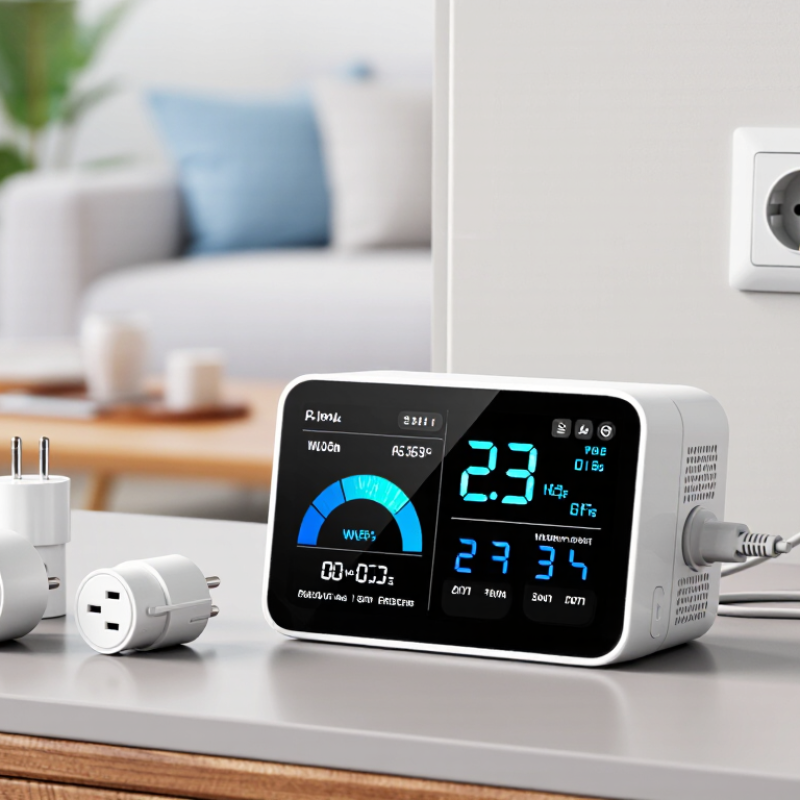
For global buyers, a portable energy monitor is more than a screen with a battery. IEC 61557-12 defines performance requirements for power metering and monitoring devices. It addresses measured quantities, operating conditions, and declared performance. Class 0.5 generally indicates a maximum permissible error of 0.5% under specified reference conditions. Class 1.0 allows 1.0%. These classes do not automatically cover every reading.
In field work, I check voltage, current, active power, energy, frequency, and phase angle separately. Sensor accuracy matters as much as the monitor itself. A long lead, low power factor, or loosely closed current clamp can distort results. At light loads, percentage error may become surprisingly large. The label alone is not enough. Buyers should request the uncertainty statement, test conditions, calibration traceability, and applicable frequency range. IEC 61557-12 compliance should be read with the exact declared function, not treated as a universal quality stamp.
This discipline supports practical energy audits. The IEA’s Energy Efficiency 2023 report recorded a 2.2% improvement in global energy intensity during 2022. Even small measurement errors can hide savings in motors, compressed-air systems, or temporary site loads. A sensible check compares the portable unit with a calibrated reference meter at several loads. I would repeat the test after transport. That step is easy to skip. It should not be. For international use, confirm voltage category, plug arrangements, safety markings, data export, and local calibration acceptance before purchase.
Portable Energy Monitor Accuracy Classes
IEC 61557-12 power-measuring and monitoring equipment is commonly specified with accuracy classes such as 0.5 and 1.0. The chart shows the corresponding reference maximum relative error at a full-scale measurement point: lower values indicate better accuracy. Actual performance also depends on operating conditions, sensor accuracy, power factor, temperature, and installation.
Global Safety Compliance: IEC 61010-1, UL 61010-1, CE, and RoHS
A portable energy monitor should be easy to carry, but safety compliance matters more than pocket size.
IEC 61010-1 addresses electrical measurement equipment used in controlled environments. It covers protection against shock, fire, overheating, and mechanical hazards. For buyers in North America, UL 61010-1 may support local acceptance when properly evaluated. Do not treat a printed mark as complete proof.
CE marking indicates the manufacturer declares conformity with applicable European requirements. It is not always a single laboratory certificate. Ask for the EU Declaration of Conformity, relevant test reports, and the product’s rated voltage range. RoHS focuses on restricted substances in electrical and electronic products. These documents should match the exact model, revision, and production status. Small mismatches can create large purchasing problems.
Tips: Check labels, manuals, and certificates together. Confirm measurement category ratings, insulation details, and enclosure protection before field use. Request calibration information for voltage and current readings. Also verify whether the device supports your plug, grid frequency, and local language requirements. In my experience, suppliers often provide general documents first. That is not enough. A careful buyer should request model-specific evidence and keep records for inspection. Compliance can still be misunderstood, especially when market rules change.
Connectivity and Data Logging: Bluetooth, Wi-Fi, Modbus, and 1,000+ Records
For global buyers, a portable energy monitor should offer more than a readable screen. Connectivity determines how easily measurements move from a site visit to a useful report. Bluetooth works well for close-range checks in workshops, rental properties, and factory panels. It usually needs less setup than Wi-Fi. That simplicity matters.
Wi-Fi supports remote viewing when the installation has stable internet access. However, thick walls, weak signals, and restricted networks can interrupt updates. Modbus is more suitable for professional systems. It can transfer voltage, current, power, and energy readings to a control platform, provided the wiring and register settings are correct. Always verify regional communication requirements before deployment.
Data logging is equally important. Storage above 1,000 records can preserve short inspections or several days of monitoring, depending on the sampling interval. A five-minute interval creates far more data than hourly recording. Check whether records include timestamps, peak values, and export options. Clear files make technical review easier.
In practice, I would test every connection before purchasing in volume. Bluetooth may pair quickly, yet Wi-Fi could fail in a metal cabinet. Modbus can be stable, but configuration errors are easy to miss. I have also seen users trust stored readings without checking the clock settings. That weakens the report. A dependable monitor should make gaps visible, protect records from accidental loss, and provide data that another technician can audit. No system is perfect. Test the weak points.
Buyer Selection by Application, Measurement Class, Battery Life, and Total Cost
Top Portable Energy Monitor for Global Buyers?
The best portable energy monitor depends on the application, not its appearance. Home audits need clear readings for voltage, current, power, and consumption. Industrial technicians may require wider ranges, logging, and safer probe insulation. Construction teams often value rugged housing and simple controls. A high measurement class improves confidence, but it can raise the purchase price. Check accuracy across the expected load, not only at ideal laboratory conditions. Small errors become expensive when equipment runs continuously.
Battery life also changes the buying decision. A monitor lasting one work shift may suit short inspections. Multi-day surveys need larger capacity, low-power modes, or replaceable batteries. Charging time matters in remote locations. Total cost includes probes, calibration, protective cases, software, shipping, taxes, and future service. This part is often underestimated. I have seen buyers choose a cheaper meter, then spend more on accessories and recalibration. That mistake is avoidable, though not always obvious.
Tips: Match the measurement class to the risk of error. Compare battery performance under real logging conditions. Confirm local electrical safety requirements before purchase. Keep calibration records. A portable monitor is only as reliable as its setup, operator, and maintenance. Some specifications look impressive but lack practical test details. Ask for evidence.