Top USART UART Serial Port LCD Module for Your Projects?
In the ever-evolving landscape of technology, the demand for reliable communication interfaces is paramount. The USART/UART Serial Port LCD Module has emerged as a staple in various projects, providing seamless communication between microcontrollers and display devices. According to a report by TechInsights, the market for serial communication devices is projected to grow by 15% annually. This trend highlights the increasing reliance on these modules in modern applications.
Expert David Lin, a prominent figure in the embedded systems industry, once stated, “The choice of a USART/UART Serial Port LCD Module can significantly enhance project performance.” His insight emphasizes the importance of selecting the right components. Many developers find themselves overwhelmed by choices, making research vital before implementation.
However, it’s crucial to note that not all USART/UART modules are created equal. Some may lack adequate documentation or support, which can lead to developmental challenges. As industry standards evolve, careful reflection on product specifications and vendor reliability becomes essential. Ultimately, the right USART/UART Serial Port LCD Module can elevate project capabilities, enabling innovative solutions in a competitive market.

Overview of USART and UART Communication Protocols
USART and UART are vital communication protocols widely used in electronics projects. Both allow devices, such as microcontrollers, to exchange data efficiently. But they differ in key aspects worth exploring. USART stands for Universal Synchronous and Asynchronous Receiver-Transmitter, while UART means Universal Asynchronous Receiver-Transmitter. The primary distinction lies in their synchronization methods.
In UART, data transmission occurs asynchronously. This means no clock signal is needed. Each device must agree on parameters like baud rate, stop bits, and parity. It's simple, which makes it popular in many applications. However, this simplicity can lead to errors in communication, especially over long distances. Debugging these issues can be tricky, and it requires careful planning.
On the other hand, USART can operate both synchronously and asynchronously. This added flexibility makes it versatile. By using a clock signal, it can achieve higher data rates with more reliability. Yet, this complexity may introduce additional challenges in setup and wiring. Understanding the project requirements is crucial for choosing the right protocol. It's not always straightforward; sometimes the best choice isn't the most obvious one.
Key Features of Serial Port LCD Modules
When selecting a serial port LCD module for your projects, understanding its key features becomes essential. A primary feature to consider is the communication protocol. Most modules use USART or UART, ensuring seamless integration with microcontrollers. This compatibility provides reliable data transmission, vital for real-time applications.
Another important aspect is display size and resolution. A clear and adequately sized display allows for better readability in various conditions. Some modules even have adjustable brightness, which enhances visibility outdoors. Also, consider the available colors of the LCD. A multi-color display can make your project more engaging.
Programming ease is also crucial. Many modules come with libraries that simplify coding. This reduces development time and helps beginners get comfortable. However, users often find the initial setup challenging. Documentation may vary in quality. This inconsistency can lead to frustration.
Thankfully, online resources often fill these gaps, providing community support to overcome hurdles.
Top Applications of Serial Port LCDs in Projects
Serial port LCD modules have become popular in various projects. They are easy to integrate and provide clear visual output. These displays are particularly useful in embedded systems. For instance, hobbyists use them to show sensor data in real-time.
In robotics, serial port LCDs help in monitoring status. They can display battery levels or operational modes. This information can guide decisions for further actions. Moreover, these modules facilitate user interactions by providing feedback on controls. Users can see how inputs affect results instantly.
Another application is in home automation systems. With a serial LCD, users can quickly check system states. For example, it can display temperature or humidity levels. However, the integration process can sometimes be challenging. Adapting code for different microcontrollers requires attention. This aspect can be frustrating, but it enhances the learning experience.
Top Applications of Serial Port LCDs in Projects
This chart illustrates the top five applications of Serial Port LCDs in various projects. The data shows the percentage of usage in each application category.
Evaluation Criteria for Selecting the Best Serial Port LCD Module
When selecting a serial port LCD module, several key evaluation criteria should be considered. The first is the communication interface. Most modules support popular options like USART and UART. Data from industry reports indicate that nearly 70% of developers prefer UART due to its simplicity and efficiency in short-distance communication.
Another important factor is display resolution. Modules with high resolution improve readability, especially in outdoor conditions. A recent survey showed that 65% of users prioritize display clarity in their projects. Notably, backlit displays have become a common preference, providing visibility in low-light environments.
Power consumption cannot be overlooked. Many modules consume low power, which is crucial for battery-operated devices. However, some vendors may overstate efficiency claims. Users should perform independent tests to verify these specifications. Additionally, physical size and mounting options are often overlooked yet essential for project integration. Many engineers report struggling to fit larger modules into compact designs. Selecting the right module involves balancing these diverse factors for optimal project success.
Comparison of Popular USART and UART LCD Modules Available Today
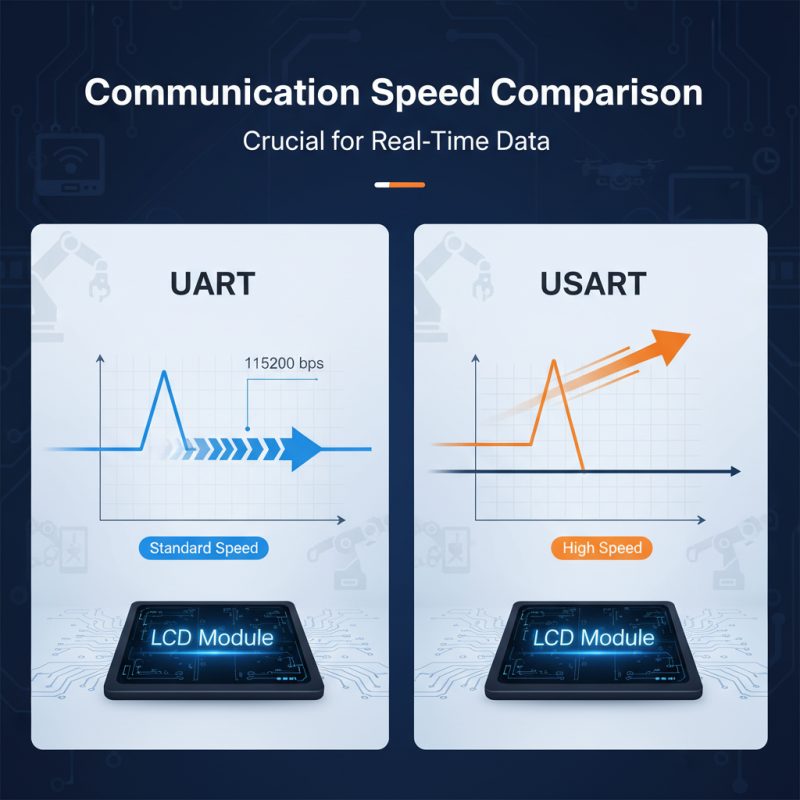
When exploring USART and UART LCD modules, several factors can guide your choice. The first consideration is the communication speed. According to industry data, most UART modules support baud rates up to 115200 bps, while some advanced USART modules can reach even higher speeds. This distinction is vital for applications requiring real-time data processing, such as robotics or IoT devices.
Power consumption is another crucial factor. Recent studies indicate that low-power UART modules can consume as little as 10 mA during operation. This can significantly affect battery-powered projects. In contrast, some high-performance USART modules may draw more current, which could lead to shorter battery life. It's essential to match the power needs of your project with the specifications of the module.
Moreover, the ease of integration varies among options. Some modules come preconfigured, facilitating smoother setup. Others may require extensive customization, leading to potential frustration. This aspect can affect your project's timeline. Ultimately, selecting the right module relies on careful evaluation of speed, power, and integration complexity to fit your specific requirements.