How to Choose the Right LCD Module for Your Project?
Choosing the right LCD module for your project can be challenging. Various factors impact your decision. The LCD module technology, size, and resolution are crucial. Each project has specific requirements.
Understanding these aspects will help you make an informed choice. Do you need a touchscreen or a standard display? Different applications call for different features. For example, outdoor projects require sunlight-readable displays.
Reflection on your project's scope can steer your selection. Remember that not every LCD module suits your needs perfectly. Balance between performance and cost is vital. Take your time to evaluate options. Making the right choice enhances your project’s success.
Understanding the Different Types of LCD Modules Available
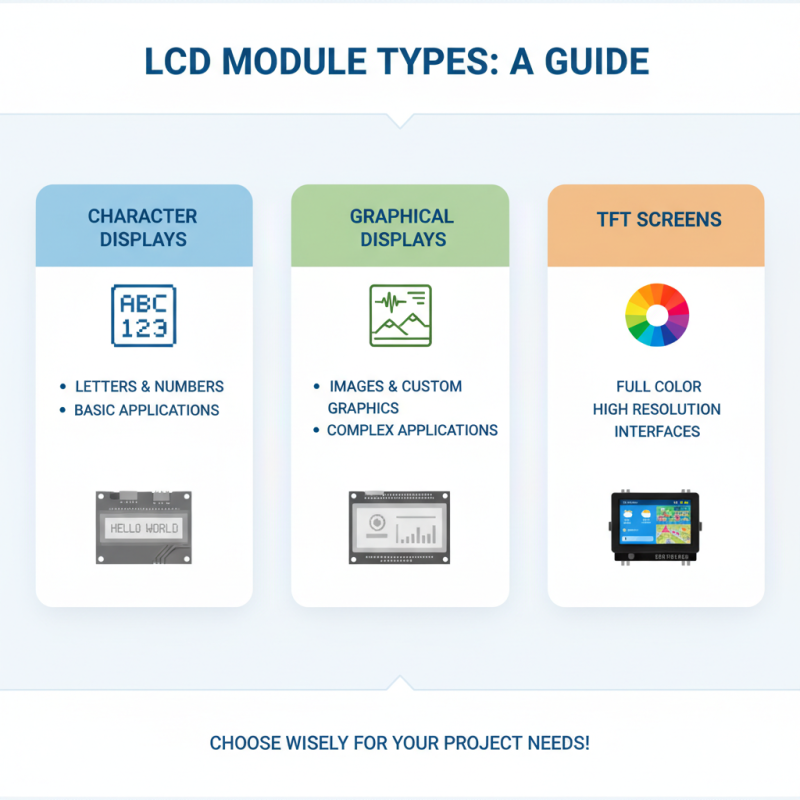
When selecting an LCD module, understanding the types available is crucial. LCDs can be segmented into several categories: character displays, graphical displays, and TFT screens. Character displays are simple, showing letters and numbers. They are efficient for basic applications, but limited in functionality. Graphical displays offer more versatility. They can render images and custom graphics, making them suitable for complex applications.
The TFT (Thin-Film Transistor) LCDs are gaining popularity. Data from industry reports indicate that TFT technology accounts for over 60% of the LCD market. These displays provide higher resolutions and better color reproduction. However, they may require more power and a complex interface. This could complicate your project. Understanding power consumption is vital, as it impacts battery life in portable devices.
Additionally, consider display size and resolution. A larger screen enhances visibility but may increase costs. Resolution affects clarity and detail. Higher resolution means better visual quality but also more processing power. It’s essential to balance project needs with budget constraints. Sometimes, a simple solution is more effective than a high-end display. Reflecting on these choices can lead to better decisions in your project design.
Key Specifications to Consider When Selecting an LCD Module
When selecting an LCD module for your project, some specifications demand attention. Resolution plays a pivotal role. A higher resolution provides clearer images. Consider how this impacts your design. A module with 128x64 pixels may suffice for simple graphics. However, intricate details require a 640x480 resolution at a minimum.
Next, brightness and contrast ratios are vital for visibility. If your device operates outdoors, choose a display with higher brightness. Think about how sunlight might wash out your screen. Contrast ratios help in different lighting. A 1000:1 ratio enhances visibility in challenging environments. Evaluate how these factors align with your needs.
Touch capabilities can also influence your choice. A touchscreen can enhance interaction. Yet, it may add to the complexity. Consider whether users will need this feature. Additionally, the backlight type matters. An LED backlight consumes less power. But, an LCD with CCFL backlight may provide different performance. Reflect on the impact of these options on your project's goals.
How to Choose the Right LCD Module for Your Project?
| Specification |
Details |
| Display Size |
2.0" to 7.0" |
| Resolution |
240x320, 640x480, 800x480 |
| Interface Type |
SPI, I2C, Parallel |
| Backlight Type |
LED |
| Operating Temperature |
-20°C to 70°C |
| Power Consumption |
< 200 mA |
| Viewing Angle |
60° to 80° |
Assessing the Size and Resolution Requirements for Your Project
When selecting an LCD module, size and resolution play crucial roles. The physical dimensions of the screen determine how it fits in your project. A small device may require a compact screen. In contrast, larger installations could accommodate more expansive panels. Think about where the module will be displayed. Will it be handheld, or will it sit on a desk? Each scenario dictates a different size requirement.
Resolution is equally vital. Higher resolutions yield clearer images and finer details. However, increased resolution can also lead to more complex design challenges. Determine the intended use of the display. A simple menu may work fine on a lower resolution. In contrast, graphics-heavy applications demand sharper clarity. Consider how users will interact with the display. If they will need to read small text, a higher resolution becomes necessary.
While these factors might appear straightforward, the balance is tricky. A too-large screen might overwhelm a compact design. Conversely, a tiny resolution could deter users. Each decision should consider usability for the end-user. Reflecting on these aspects ensures a better choice, enhancing your project’s outcome.
Display Size and Resolution Requirements for LCD Modules
Evaluating Interface Options for Compatibility with Your System
When selecting an LCD module, compatibility with your system is crucial. The interface options available can heavily influence performance and ease of integration. For instance, common interfaces include I2C, SPI, and parallel connections. Each option has its benefits and drawbacks. I2C uses fewer wires, simplifying connections. However, it may be slower than other options. SPI offers faster data transfer but requires more pins, which can complicate design.
Evaluating these options requires careful consideration. Does your microcontroller support the desired interface? Some systems are limited in their compatibility. You might find an LCD that fits your size and resolution needs. Yet, if it uses a non-compatible interface, it becomes an obstacle. It's essential to check datasheets and specifications thoroughly.
Testing different modules can also reveal unforeseen challenges. You may experience issues with timing and data integrity. Sometimes, even simple wiring errors can lead to failures. Ensuring proper signal levels and voltage tolerances is vital. Integration might not be as straightforward as it seems, and these small details can significantly impact your project's success.
Budgeting and Sourcing: Finding the Right LCD Module for Your Needs
When budgeting for an LCD module, consider the project's scale. A small hobby project may not need advanced features. A simple display can suffice. However, for professional projects, quality is key. Higher resolution and brightness might be necessary. Evaluate how much you can allocate without compromising your design goals.
Sourcing options can be overwhelming. Many platforms offer a range of LCD modules. Some might have competitive pricing, but be cautious. Quality varies significantly. Reading reviews can help, but are they reliable? Some users may exaggerate their experiences. Always check certifications and specifications. Local suppliers can be beneficial too. They might provide quicker support, reducing potential downtime.
Don't forget about hidden costs. Shipping fees can add up, and lead times may affect your schedule. Exploring bulk purchasing options could be worthwhile. It might save money in the long run. However, ensure you truly need the quantity. Extra modules might sit unused, straining your budget. Balancing cost and functionality is crucial for a successful project.